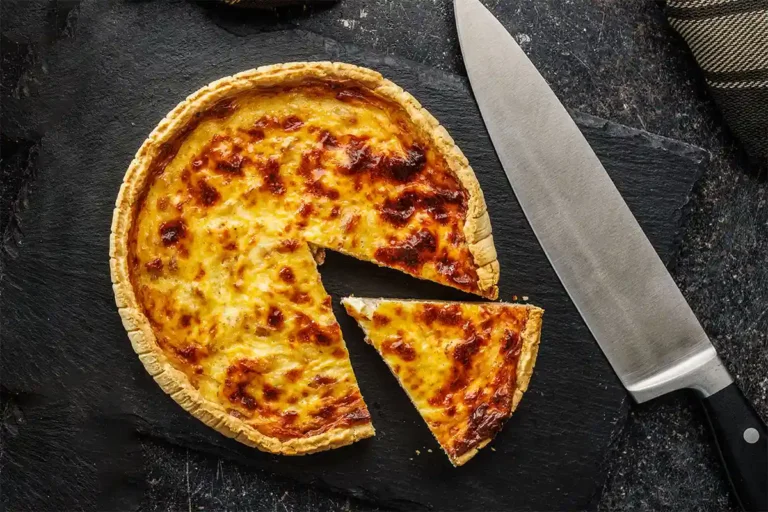
1 all-butter pie crust (shortcrust pastry, homemade or store-bought)
7 oz smoked lardons or thick-cut bacon, cut into matchsticks
3 whole eggs
1 cup (8 fl oz) heavy whipping cream
⅔ cup (5 fl oz) whole milk
1 pinch freshly grated nutmeg
Fine salt and freshly ground black pepper
🥘 Preparation Steps
Blind bake the crust
💡 Before preparing the custard, start by blind-baking the crust to prevent it from getting soggy during baking.
Preheat your oven to 350°F on convection (fan) setting.
Line your tart pan with the pastry and prick the bottom with a fork.
Cover the bottom with parchment paper, then weigh it down with pie weights (or dried beans).
Bake on the middle rack for 12 minutes at 350°F.
👨🍳 To minimize moisture absorption, lightly brush the pre-baked crust with a beaten egg white and return it to the oven for 2 minutes.
Prepare the quiche custard
💡 Use room temperature ingredients.
Sauté
Sauté (or Saute) is a cooking technique that involves quickly cooking food in a small amount of fat over medium-high heat. The goal is to brown the ingredients while keeping them tender, often by “tossing” them in the pan.
the lardons (or bacon) in a dry skillet over medium heat for 5 to 6 minutes. Do not add any fat.
Once nicely browned, drain them on paper towels to remove excess fat.
In a large bowl, whisk the eggs, then add the cream and milk.
Season with a little salt, pepper, and a pinch of nutmeg.
Mix gently until you get a smooth and perfectly combined custard.
👨🍳 I always salt the custard a bit, but be careful with the amount: the bacon already adds a good dose of salt.
Bake the Quiche Lorraine
Distribute the cooked lardons evenly over the bottom of the pre-baked crust.
Pour the egg-cream-milk mixture over the top.
Bake for 35 to 40 minutes, still at 350°F, until the surface is golden brown and slightly puffed up.
Let it cool for 10 to 15 minutes before serving to allow the texture to set perfectly.
And there you have it, serve your Quiche Lorraine while still warm, accompanied by a crisp green salad. Simple, rustic, and always a hit at the dinner table.
Bon appétit 😋
Tips for a Perfect Quiche Lorraine
Crispy bottom crust
Right after blind baking, brush the tart shell with a lightly beaten egg white, then put it back in the oven for 2 minutes at 350°F.
💡 As it bakes, the egg white proteins coagulate and create a thin waterproof barrier that prevents the custard from making the pastry soggy.
👨🍳 For a richer version, you can replace the egg white with a small knob of melted butter.
Let the custard rest before pouring
Once the eggs, cream, and milk are mixed, let the custard rest at room temperature for about ten minutes.
💡 This allows the air incorporated during whisking to escape and the proteins to relax.
You will get a smoother texture, without bubbles or cracks after baking.
Slice the quiche warm, not piping hot
Many people slice it right out of the oven: that’s a mistake.
The eggs and cream haven’t finished setting, and the structure isn’t stable.
💡 By waiting 15 to 20 minutes, the quiche settles: the knife glides cleanly through, without cracking the slices or crushing the pastry.
Variations
Cheese Quiche Lorraine
Yes, the traditional Quiche Lorraine does not contain cheese, but you can certainly bend this rule:
Add 3.5 oz of grated cheese (Gruyère, Emmental, or Comté).
⚠️ Do not exceed 3.5 oz of cheese, otherwise, the quiche will lose its lightness.
Onion Quiche Lorraine
Melt 2 thinly sliced onions over low heat for 10 minutes in a little butter, then mix them with the bacon before baking.
Their sweetness balances the smokiness of the bacon.
Herb Quiche Lorraine
Stir a little chopped chives or flat-leaf parsley into the mixture: these herbs pair perfectly with the cream, eggs, and bacon.
Side Dishes
Crisp Green Salad
A mix of baby greens, lamb’s lettuce, or romaine, dressed with a whole-grain mustard vinaigrette.
Cherry Tomato and Red Onion Salad
Brings freshness and a perfect tangy touch to balance the richness of the quiche.
Seasonal Soup
In autumn or winter, serve a pumpkin velouté or a leek soup for a complete and comforting meal.
Storage
In the refrigerator: 3 days in an airtight container.
Freezing: Up to 2 months, once completely cooled.
Reheating: 10 mins in the oven at 320°F (160°C) or 1 min 30 in the microwave at 600W. If frozen: 20 mins at 320°F (160°C), without defrosting, to keep it crispy.
FAQ: Frequently Asked Questions
What is the best pastry for a quiche?
An all-butter shortcrust pastry (pâte brisée) is the most suitable: it stays firm and doesn’t get soggy. Puff pastry gives a crispier result but is less stable when sliced.
Should you cook bacon before putting it in a quiche?
Yes. Sauté them in a dry pan for 5 to 6 minutes over medium heat to render the fat and concentrate the flavor, then drain them before placing them on the pastry.
How do you get a quiche to puff up well?
Use room-temperature eggs and a well-preheated oven at 350°F. Convection heat (fan oven) helps the cream expand and puff without collapsing.
What kind of cream should I use for Quiche Lorraine?
Opt for thick crème fraîche (30% fat) or heavy whipping cream. It provides the creaminess and structure of the custard, unlike light or reduced-fat creams which are too liquid.
Can you put cheese in a Quiche Lorraine?
Not in the traditional version, but you can add 3.5 oz of Gruyère, Emmental, or Comté for a more melt-in-the-mouth quiche.
Feel free to leave a comment or share your tips 👨🍳
Pour offrir les meilleures expériences, nous utilisons des technologies telles que les cookies pour stocker et/ou accéder aux informations des appareils. Le fait de consentir à ces technologies nous permettra de traiter des données telles que le comportement de navigation ou les ID uniques sur ce site. Le fait de ne pas consentir ou de retirer son consentement peut avoir un effet négatif sur certaines caractéristiques et fonctions.
Fonctionnel
Always active
L’accès ou le stockage technique est strictement nécessaire dans la finalité d’intérêt légitime de permettre l’utilisation d’un service spécifique explicitement demandé par l’abonné ou l’utilisateur, ou dans le seul but d’effectuer la transmission d’une communication sur un réseau de communications électroniques.
Préférences
L’accès ou le stockage technique est nécessaire dans la finalité d’intérêt légitime de stocker des préférences qui ne sont pas demandées par l’abonné ou l’internaute.
Statistiques
Le stockage ou l’accès technique qui est utilisé exclusivement à des fins statistiques.Le stockage ou l’accès technique qui est utilisé exclusivement dans des finalités statistiques anonymes. En l’absence d’une assignation à comparaître, d’une conformité volontaire de la part de votre fournisseur d’accès à internet ou d’enregistrements supplémentaires provenant d’une tierce partie, les informations stockées ou extraites à cette seule fin ne peuvent généralement pas être utilisées pour vous identifier.
Marketing
L’accès ou le stockage technique est nécessaire pour créer des profils d’internautes afin d’envoyer des publicités, ou pour suivre l’utilisateur sur un site web ou sur plusieurs sites web ayant des finalités marketing similaires.